Lockheed NC-121K Warning Star pic.twitter.com/wi7BV39b5z
— Ron Eisele (@ron_eisele) January 26, 2019
If you click on the photograph and when the Twitter page appears, click on it again. You will see two C-121s with Air Force markings in the background.
The Lockheed EC-121 Warning Star was an American Airborne early warning and control radar surveillance aircraft used from the 1950s by the United States Navy and United States Air Force.
This military version of the Lockheed L-1049 Super Constellation was designed to serve as an airborne early warning system to supplement the Distant Early Warning Line, using two large radomes, a vertical dome above and a horizontal one below the fuselage. Some EC-121s were also used for intelligence gathering (SIGINT).
It was introduced in 1954 and retired from service in 1978, although a single specially modified EW aircraft remained in service with the U.S. Navy until 1982.
The U.S. Navy versions when initially procured were designated WV-1 (PO-1W), WV-2, and WV-3. Warning Stars of the U.S. Air Force served during the Vietnam War as both electronic sensor monitors and as a forerunner to the Boeing E-3 Sentry AWACS. U.S. Air Force aircrews adopted the civil nickname, “Connie” (diminutive of Constellation) as reference, while naval aircrews used the term “Willie Victor” based on a slang version of the NATO phonetic alphabet and the Navy’s pre-1962 “WV-” designations for the aircraft type.

Ever wonder how BIG the Pentagon really is? Or what goes on inside the five-sided, self-contained city?
From The New York Times website
Some significant expenses decline as we age: Most mortgages are eventually paid off, and ideally children grow up and become self-supporting.
But health care is one area in which costs are almost certain to rise. After all, one of the original justifications for Medicare — which kicks in at age 65 — is that older people have much higher health care needs and expenses.
But there are a few common misunderstandings about health costs when people are older, including the idea that money can easily be saved by reducing wasteful end-of-life spending.

Hawaii Air National Guard Photograph | click to enlarge
This undated photograph shows a young Adrian “Kila” Kinimaka, who flew with the 199th Fighter Squadron. It looks like the photograph was taken at the Hawaii Air National Guard flightline. Kila is wearing a Tactical Air Command or Air Combat Command patch so the date should be in the early 1990s, shortly after he returned from training.
Historical note: Tactical Air Command transitioned into the Air Combat Command effective June 1, 1992.
You can register to receive an email every time there is a new post.
In the “Follow Retiree News via Email” section, on the right column of the website – enter your email address and press “Follow”.
Shortly, you will receive a confirmation email to your address from WordPress.com. You acknowledge the email and you are a registered reader.
After you compete this short registration process, you get a notification email every time there is a new posting. The email has a quick teaser of the posting, along with tags that indicate how the posting relates to special topics/areas. There is a direct link to the website (Read more of this post)
 click on graphic to enlarge
Thanks to these Retiree News readers who registered to “Follow Retiree News via Email”:
jovitamacfarland22, madelainechatfield, warrcetsr, ellac43, jespinoza27, wiba808, piroive95, gogovernors, habsupply72, chrjr13, bobbiehorne, Howard Nonaka, riachuelo29, frank-pocaigue, Fred Miura, Andrew Partika, raykess89, George Woolworth

Perfect spring weather, fragrant flowers sewn into colorful garland lei and the sounds of Hawaiian music on Kauai can only mean one thing – it’s May Day in Hawaii! Held on May 1 each year, May Day is a statewide celebration of the aloha spirit and the giving of the flower lei. A famous song captures the essence of May Day best, “May Day is Lei Day in Hawaii, garlands of flowers everywhere, all of the colors in the rainbow, maidens with blossoms in their hair.”

This photograph shows a Hawaii Army National Guard (HIARNG) Nike Hercules missile battery at Bellows Field, Waimanalo.
This Nike Hercules defense area was manned solely by Hawaii Army National Guard personnel. Early plans called for six individual batteries, this was changed to six batteries at four locations – Bellows, Kahuku, Mokuleia, Makakilo – ringing the island. Site construction began in the late 1950s. Command of the defense area came under US Army, Pacific (USARPAC).
Units and installations defended included Pearl Harbor Naval Base, Naval Submarine Base and Naval Shipyard, Marine Corps Air Station Kaneohe Bay, Naval Air Station Barbers Point, Wheeler AFB, and Hickam AFB.
The Army Air Defense Command Post (AADCP) was located at Wahiawa, the early warning radar site was Mount Kaala AFS and was operated jointly by Pacific Air Forces, the Federal Aviation Administration (FAA), and Hawaii Air National Guard (HIANG).
Nike Hercules operation in Hawaii ended in 1970. Many HIARNG technicians transferred to the HIANG positions to continue their full time employment.

Sure, we all intend to have our emergency kits packed and ready to go, but how many of us really get around to making it happen?
Let’s change that.
We asked Helen Chavez, assistant director with the Los Angeles County Office of Emergency Management, to give us some tips for emergency prep.
Top of her list is something that’s actually free: a conversation with your loved ones about your emergency plans. Specifically, what’s the plan for everyone to get out of your house, where will you all meet once you’re safely out, and how can you contact each other if you’re not at home when disaster strikes?
Voice analysis software can help detect post-traumatic stress disorder (PTSD) in veterans based on their speech, a study suggests.
Doctors have long understood that people with psychiatric disorders may speak differently than individuals who do not have mental health problems, researchers note in Depression and Anxiety. While some previous research points to the potential for distinct speech patterns among people with PTSD, it’s been unclear whether depression that often accompanies PTSD might explain the unique voice characteristics.
In the current study, voice analysis software detected which veterans had PTSD and which ones did not with 89 percent accuracy.
Personal photograph used with permission
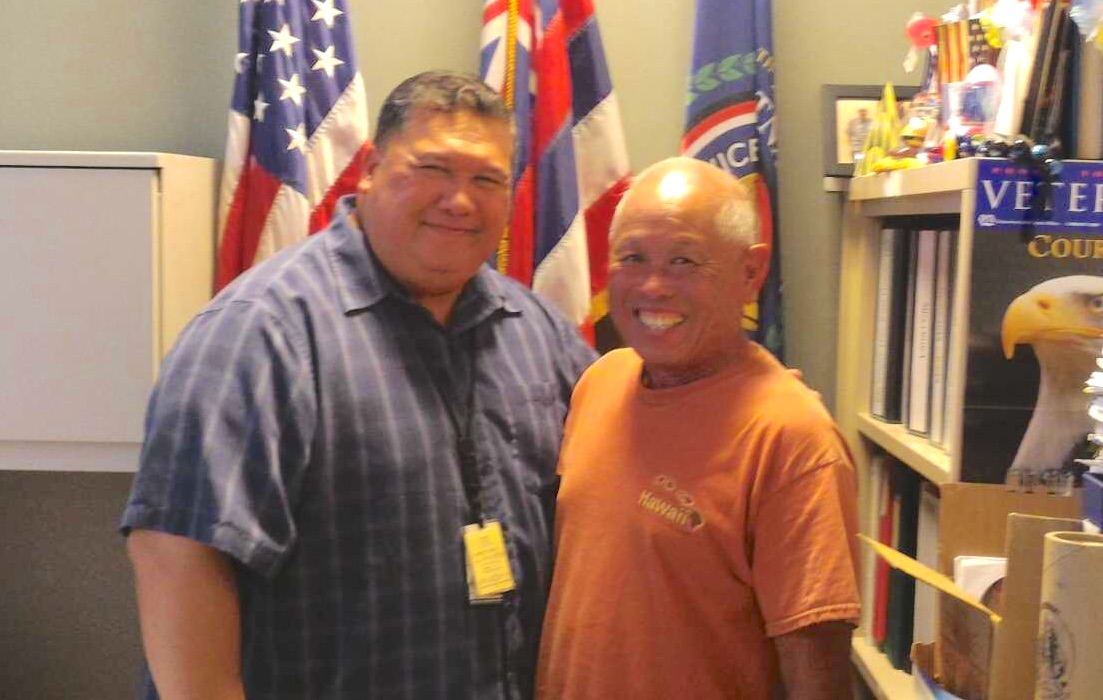
Thanks to John “JC” Chun for emailing this photograph to Retiree News. John was visiting the Department of Veterans Affairs (VA) office in the Tripler Army Medical Center. Across the hall in “E” Wing is the State Office of Veterans Service (OVS). JC ran into Ronald Han, the Director of the Office of Veterans Service.
When he retired from the Hawaii Air National Guard (HIANG), Ron was the commander of the 154th Maintenance Group. Coming out the of the Air Force, He joined the HIANG, serving in the 154th Logistics Readiness Squadron. He later moved to the maintenance side of the group before serving as group commander. After retiring, he was named the OVS Director by Governor Neil Abercrombie. He was recently reappointed by Governor David Ige.
JC started in the engine shop and served there for many years. With the integration of computers in the maintenance process, he becomes more involved with engine tracking and analysis.
From the Defense Finance and Accounting Service (DFAS) website
 You already know that myPay is the most convenient way to manage your DFAS miltary, civillian employee, or miltary retired or annuitant pay account and get the tax documents you need. This spring, myPay will change, making it simpler and more convenient to use.
When you use myPay after tax season this year, you will see some big differences. The most striking difference will be the appearance of the myPay home page, which will look more like other online financial sites you are used to seeing, with the login area on the right side instead of the left, a banner area with important information, and quick links at the top. The home page will also appear more modern.
When you log in to myPay after the change, you will also see a streamlined navigation menu. The same menu choices will be available, but they will be organized into categories and the menu will appear on the left side on every page.
Another change is that myPay will be easier to use on your favorite mobile device. When you use myPay on your mobile browser, the menus and screens will adjust to your mobile device.
What will not change is your login ID and password; they will transfer over. The same login ID and password you use before the transformation, you will use after (as long as your password has not expired). And the “Forgot your Login ID?” and “Forgot or Need a Password?” options will be the same.
After the changeover, you will see a myPay that looks different. You can always ensure you are connecting to the official myPay system by checking your browser’s address bar for the correct myPay URL: https://mypay.dfas.mil.
There will also be updated video walk-throughs and FAQs to help you accomplish a variety of common online tasks, such as accessing a myPay account for the first time, password updates, and bank account and address changes.
From the Everyday Health website

When doctors see patients who exhibit signs of mild cognitive impairment or dementia, they have traditionally screened them for Alzheimer’s disease using lab tests, mental evaluations, and standard brain scans.
But while these tools provide helpful information, they do not give a conclusive diagnosis. The only way to definitely identify Alzheimer’s has been to examine brain tissue in an autopsy.
New technology involving positron emission tomography (PET), however, has been changing that. The imaging technique can spot amyloid plaques in the brain — a telltale sign of Alzheimer’s — by using a specific radioactive agent that binds to the plaques.
A study published April 2, 2019, in the Journal of the American Medical Association (JAMA) shows how amyloid PET scans may drastically alter how doctors diagnose and treat those with mild cognitive impairment or dementia.
Midtown Ala Moana is “considered a haven for foodies,” a draw for “fashionistas,” and home to The Republik nightclub, Like Like Drive Inn, and Shokudo restaurant. “Here you can start the day lying on sandy shores at Ala Moana Beach Park and end it with a night on the town singing karaoke or swaying to the sound of visiting bands,” according to MidtownAlaMoana.com.
In a stylish video produced by the Azure Ala Moana luxury condo development, Midtown Ala Moana is characterized as “the heartbeat of Honolulu,” the “vibrant urban backdrop” to a “metropolitan lifestyle.” Located between downtown Honolulu and Waikiki, local social media guru Melissa Chang says Midtown Ala Moana “looks like a very young, contemporary neighborhood, but there’s actually a lot of history here.”
 This post is from the Hawaii Blog run by Ryan Ozawa. Ryan is the Communications Director for Hawaii Information Service, a local real estate technology company, where he has worked since 2006.
Outside the office, Ryan covers science, technology, startups, entrepreneurship and the arts for a variety of outlets, including KITV, Hawaii News Now, Hawaii Public Radio, Civil Beat, and the Honolulu Star-Advertiser. He is also the organizer of the annual Hawaii Geek Meet, heading into its twelfth year.
From the Honolulu Civil Beat website
The 2019 hurricane season begins on Wednesday and runs through November 30. You will see the local television stations and the newspaper covering hurricane preparation. But over the years, reporting never really covers some of the realities of the post-disaster.
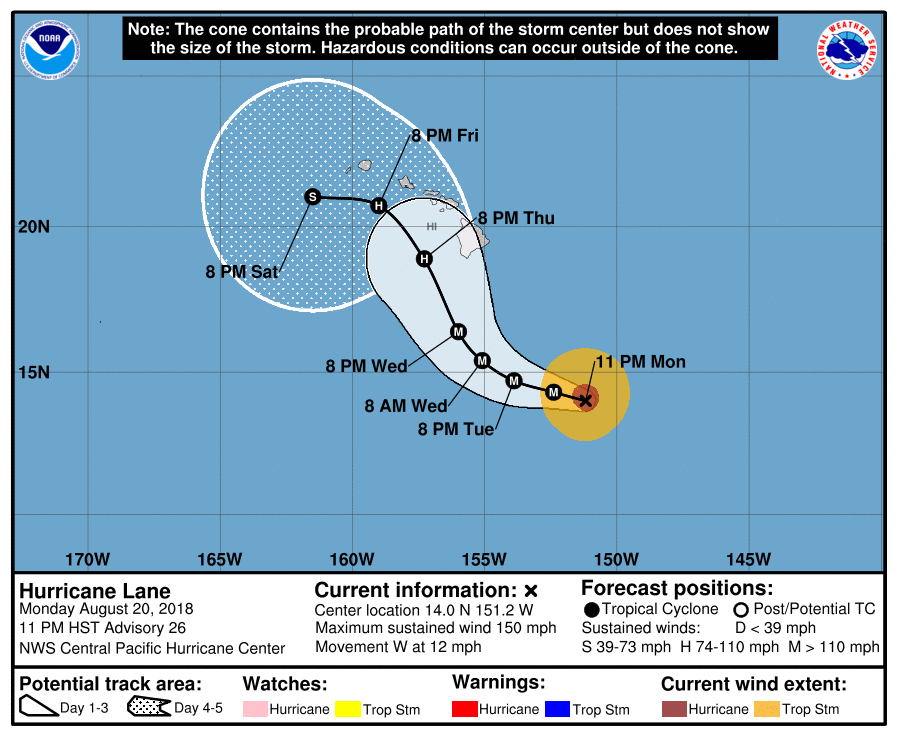
Hurricane Lane (2018) | click to enlarge
While Hawaii has been at the forefront of clean energy policy in recent years, this 2019 legislative session is turning out to be a colossal failure in terms of actually preventing and preparing for climate change.
We know the risk is huge. Up until 2014, the only hurricanes to hit Hawaii in my lifetime were Iwa (1982) and Iniki (1992). But in the last five years, there have been nine tropical storms or hurricanes which have hit, or come very close to hitting, Hawaii. That is because the increase in ocean temperatures in Hawaii waters over the last five years is fueling more tropical storms and hurricanes.
Hurricanes Lane and Olivia last year hopefully scared most of us straight in terms of being personally prepared for the next major natural disaster. That is good, but what about the fundamental structures of our community that we all rely on?
Our systems for survival — like delivering water, removing waste, providing shelter and medical care — do not seem at all ready. We are about as prepared for the next major natural disaster as Puerto Rico was when Hurricane Maria hit.
But we can learn from Puerto Rico’s experience and get prepared now. The key is moving past the self-congratulating, vague commitments to long-term goals and digging in to invest in real resiliency. There is so much to be done:
Please note that here in Hawai‘i, we need to stock water and supplies for at least 14 days. Most government websites recommend 3 days, and that is a reasonable supply if you live on the continental United States. Hawai‘i remains dependent on container ships that take a minimum of 7 days to get to Hawai‘i from Oakland or Los Angeles.