From the Medical News Today website
Shingles, also known as herpes zoster, is a disease that results from the reactivation of the varicella-zoster virus (VZV).

The primary VZV infection causes chickenpox, usually in children and young adults. This highly contagious disease causes a large rash of itchy blisters. The rash typically affects the chest and back but can spread over the entire body.
Even after a person recovers from chickenpox, VZV can live in some nerve cells for several years before reactivating as shingles.
Shingles also causes a skin rash and blisters. However, a shingles rash occurs on only one side of the body, usually appearing on the face or torso.
Not everyone who gets chickenpox will go on to have shingles. The Centers for Disease Control and Prevention (CDC) estimate that about 1 in every 3 people in the United States develop shingles during their lifetime.
There are about 1 million cases of shingles in the U.S. every year.
This article looks at the symptoms, causes, and treatment of shingles, as well as the risk factors and diagnostic process. It also explains what the outlook is for someone with shingles and when to contact a doctor.

Off the Hawaii Air National Guard Facebook page
Members of the 154th Force Support Squadron completed a week-long Home Station Readiness Training event, preparing them for all kinds of scenarios which they may encounter during a deployment.
The Airmen trained with Emergency Management professionals from the 154th Civil Engineer Squadron, raised and broke down Alaskan Small Shelter System, practiced Search and Recovery mission set, developed forward-operating procedures and much more.
Whether the day-to-day mission is taking place at home station or ‘down range,’ Force Support is always there to take care of our Airmen, our families and our partners!

The Kūkā‘ilimoku is the official e-newsletter of the 154th Wing, Hawaii Air National Guard. The first issue came in September 1957 and continues as an e-newsletter today.
Today we feature the March 1983 Kūkā‘ilimoku issue. This issue includes the following stories:
* TSgt Godwin Hashimoto receives HANG NCO Award
* Alexis Lum appointed the Adjutant General
* CAM News and View: lots of familiar names
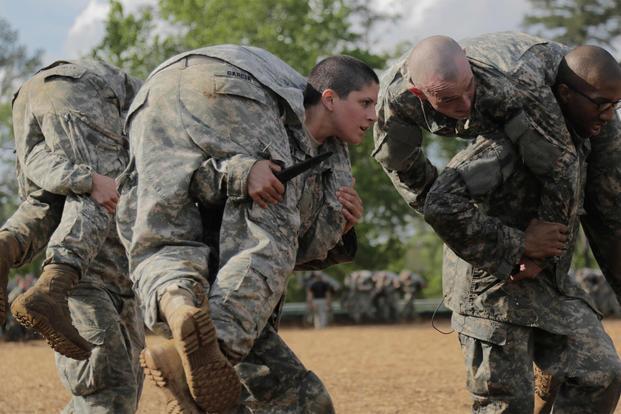
The Army’s first female infantry officer is urging the service not to revert to separate fitness standards for men and women.
In an essay posted online Thursday by West Point’s Modern War Institute, Capt. Kristen Griest said that evaluating women based on lower fitness standards would not only hurt the effectiveness of combat arms units, it also would hurt women in the Army.

Like influenza, could COVID-19 evolve to wax and wane with the seasons? New research suggests it might.
Early in the pandemic, some experts suggested that SARS-CoV-2 — the virus that causes COVID-19 — may behave like many other coronaviruses that circulate more widely in fall and winter.
To find out if that could be true, researchers analyzed COVID-19 data — including cases, death rates, recoveries, testing rates and hospitalizations — from 221 countries. The investigators found a strong association with temperature and latitude.

Hawaii-based F-22 video of maintenance ops, taxing, taking off, landing, conducting pre-flight ops, and various shots of the aircraft itself.

Every tax-filing season seems full of complexities and consternation. But the one we’re now in is especially fraught, due to the pandemic: Stimulus checks. Unemployment benefits. Working from home tax issues. New COVID-19 rules for 401(k) and Individual Retirement Account (IRA) hardship withdrawals and loans. Frankly, it’s all pretty taxing.

From the Honolulu Magazine website
Butter mochi and spam musubi on the counter, still warm in the plastic wrapper. Fresh poke mixed before your eyes. Curious house specialties, local products of wit and whimsy … You’ve got to love Hawai‘i’s hole-in-the-wall general stores.
Humble to the point of ramshackle, they’ve earned a place in our hearts for all those drive-around-the-island days of our youth, when we were starving and pooled damp dollar bills for a picnic spread on the overheated hood of a Toyota.
Sometimes, though, “you don’t know what you’ve got till it’s gone,” as Joni Mitchell reminded us. So when’s the last time you hugged Fort Ruger Market, Ching’s or Kahuku Superette? Isn’t it time you went back?
With that in mind—and hoping you can go home again—the HONOLULU team hit the road for a tasting tour. Our criteria were strict: groceries with grinds (aka no TP, no rating); some kind of food special that earned the hype; and, of course, local to the max. Some of our old favorites no longer exist; perhaps, overwhelmed by competition, they threw in the towel. But jewels in the rough abound, as you’ll see in these pages:

You may not realize it, but you’re already practicing retirement, even if your real retirement is years away.
Many of us have been working remotely over the last year, tucked away at home because of the pandemic. Except for the part where you’re actually working, life has changed much as it does for retirees.
So take a step back and ask yourself: How’s the spending coming on this retirement test drive?
Because before you can determine how much you need to save for a fulfilling retirement (and you should), you first need to know how much you will spend in retirement.
Financial planners have traditionally estimated that retirees need 80% or more of preretirement income to maintain their standard of living, though individual situations vary greatly. Another data point: According to the latest Bureau of Labor Statistics’ annual survey on consumer spending, the average retired household spends 25% less than the average working household each year.
That said, retired households do spend more than working households on many items, including big-ticket expenses such as health care and travel. Here’s a look at 10 budget categories where retirees are likely to spend more.

A popular retirement guideline suggests retirees need 80% of their preretirement income to make ends meet, and some experts encourage saving even more to avoid running out of money. Facing such daunting goals, 53% of preretirees say they plan on working past age 65 to ensure that they have enough money, according to the Transamerica Center for Retirement Studies.
But the 80% rule isn’t for everybody, and it may lead to inflated savings goals that cause undue anxiety as you plan for retirement. Consumer spending actually decreases — significantly — as you age. Data from the Bureau of Labor Statistics shows the average retired household spends 25% less than the average working household.
In order to know how much you need to save for retirement, it’s important to know what your spending will look like once you actually retire. Here’s a little pep talk: You’ve actually been practicing for retirement for the last year if you’ve been locked down this entire time.
Now, consider these 10 budget line items on which you’ll likely spend less in retirement.

A webcam atop Maunakea in Hawaii captured a singular moment: Upward-shooting red sprite & blue jet lightning to the right, the Gemini North observatory to the left, the handle of the Big Dipper in the distance.
The telescopes at Maunakea sit calmly beneath a sky filled with extraordinary light. Amongst these telescopes is Gemini North, the northern member of the international Gemini Observatory, a Program of NSF’s NOIRLab. Gemini North sits at an altitude of around 4200 meters (13,800 feet). Not only does this altitude facilitate world-class astronomical observations, but Gemini North’s nighttime Cloud Cams were able to capture the extraordinary light phenomena seen on the right side of the image.
The column of blue and red lights surrounded by a bright blaze of white light appears so otherworldly that it looks like it must be a special effect. This breathtaking image, however, is entirely real. It features two lightning phenomena: a red sprite and a blue jet.
Red sprites and blue jets are distinctive because of their colors, and also the direction in which they strike. As you can see in this image, the red and blue lights are shooting up from the top of the cloud deck, and are striking out towards space, instead of down towards the Earth. It is extremely rare to capture these phenomena on camera and even more so from this unique perspective.
National Science Foundation’s NOIRLab (National Optical-Infrared Astronomy Research Laboratory) is the preeminent US national center for ground-based, nighttime optical and infrared astronomy. The Association of Universities for Research in Astronomy, Inc. (AURA) operates these facilities and NSF’s NOIRLab under a cooperative agreement with the National Science Foundation (NSF).
From the Air Force Times website
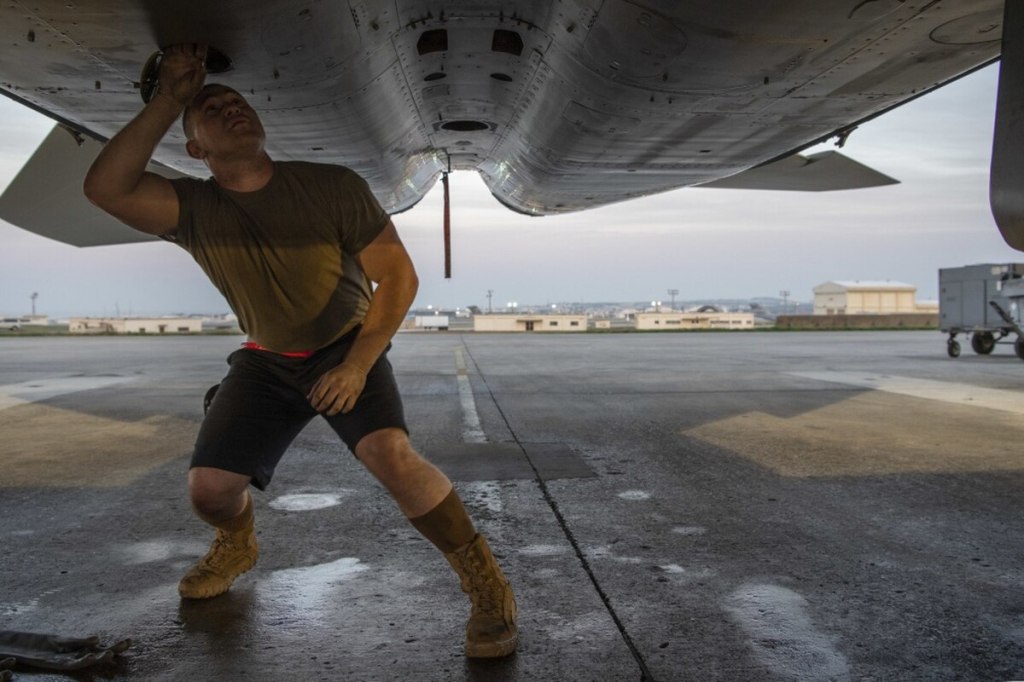
The Air Force has authorized a slew of new uniform changes — including allowing maintainers to wear shorts during warm weather across the entire force.
“These options came directly from feedback from the field through the virtual uniform board and feedback from commands in the field,” Lt. Gen. Brian Kelly, Air Force deputy chief of staff for manpower, personnel, and services, said in an Air Force news release.
“We appreciated the feedback we received from airmen and the opportunity to hear their concerns and ideas,” Kelly said. “Not all of the ideas fit within our standards or culture, but many do and provided us an opportunity to provide options for our airmen.”
Thanks to Gordon Lau for submitting this article to Retiree News
From the National Guard Association of the United States website
Museum Director Anne Armstrong shares the history of the Normandy Helmet, currently on display in the National Guard Memorial Museum in Washington D.C.
On D-Day, June 6, 1944, the 29th Infantry Division (VA, MD, DC) was part of the Allied coalition that stormed the beaches of Normandy and effectively broke the back of the German occupation of France. This helmet was part of the protective gear worn by a Guard soldier that fateful day.
From the Medical News Today website
Multiple sclerosis (MS) is a chronic disease that affects the brain and spinal cord. It is a lifelong condition that causes neurological disabilities and a wide range of symptoms.
Globally, in 2016, MS affected an estimated 2.2 million people.
It is immune-mediated, and most experts believe that it is an autoimmune disease. In a person with MS, the immune system attacks myelin, the protective sheath substance that covers nerve fibers. This causes communication problems between the brain and the rest of the body.