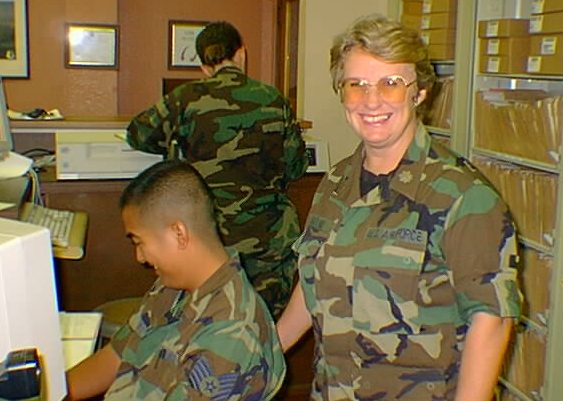
Retiree News photograph
This photograph show then-SSgt Joseph Ramos and then-Maj Susan Higgins in the early 1990s. The Consolidated Base Personnel Office (CBPO) as it was known back then was located on the second floor of the supply building.
The CBPO was renamed the 154th Mission Support Flight (154 MSF) when the function relocated to the current Mission Support building. The 154 MSF recently merged with the 154th Services Flight and in now known as the 154th Force Support Squadron.
From the Kaiser Health News website
 Kip Burgess was relieved last year when pharmaceutical giant Amgen overnighted him a $2,976 check to help pay for his go-to arthritis drug, Enbrel.
The 36-year-old psychologist had run into an increasingly common problem: The copay coupon sent by Amgen couldn’t cover the drug’s more than $4,000 monthly price.
From the Los Angeles Times website
 Yes, your brain is like a muscle: If you don’t strengthen and stretch its capacities, it will not deliver high performance.
But your brain is not like one of those forgiving muscles that lets you engage in a lifetime of indolence and then perks up willingly when you take up weight-training upon retirement. No, your brain is more like one of those muscles that will reward you for having worked it across the full length of your lifespan.
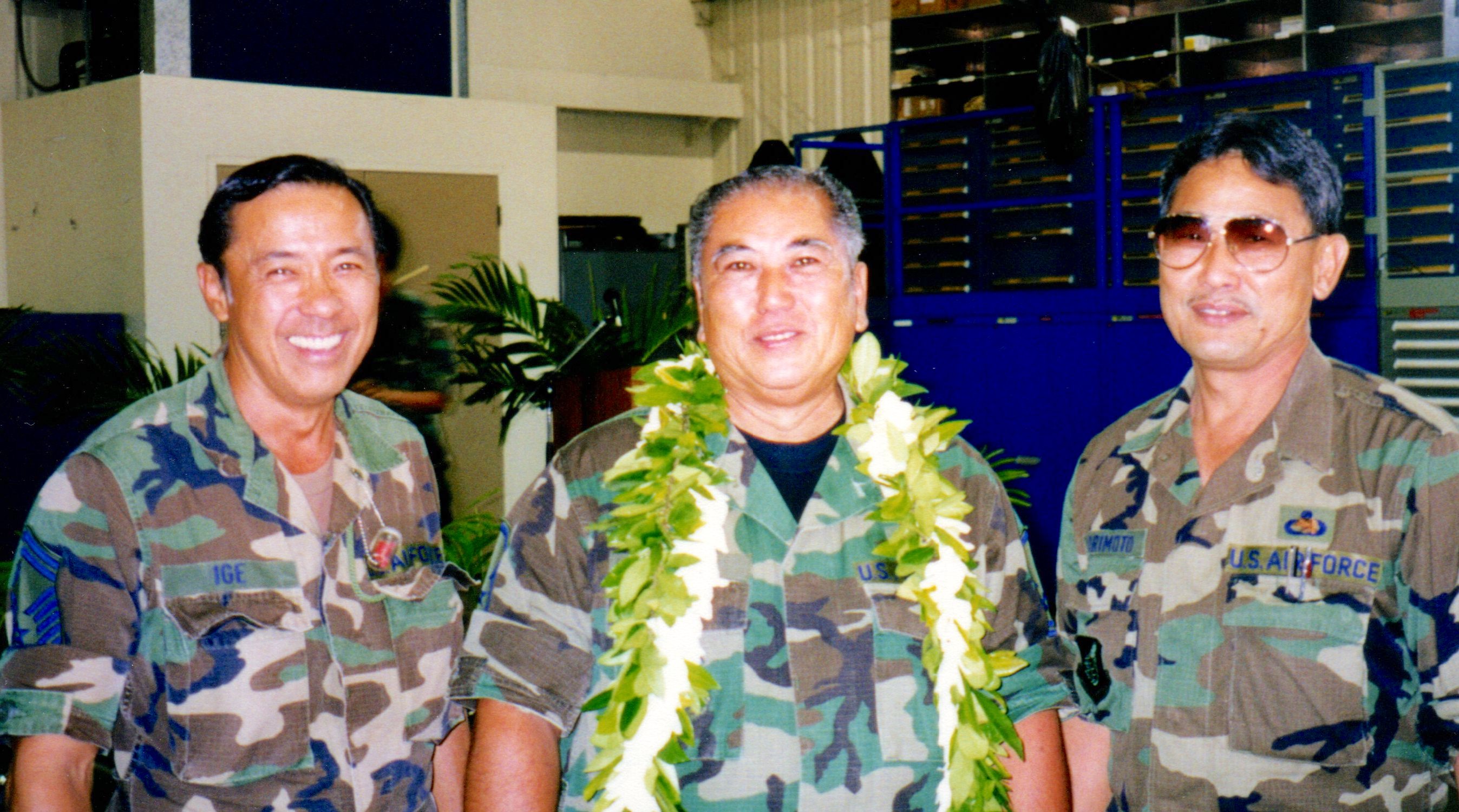
Retiree News photograph | click to enlarge
This photograph shows three maintenance supervisors – Melvin Ige, Wallace Yara, and Kenneth Morimoto. Wally was retired after many years of service in the engine shop. The engine shop hosted a retirement party for him on that drill Sunday.
Both Mel and Ken continued working for several more years before they retired.
From The New York Times website
Shari Horne broke her toes a decade ago, and after surgery, “I have plates and pins and screws in my feet, and they get achy at times,” she said.
So Ms. Horne, 66, applies a salve containing cannabidiol, derived from the cannabis, or marijuana, plant. It eases the pain.
The salve didn’t help when she developed bursitis in her shoulder, but a tincture of cannabidiol mixed with T.H.C., the psychoactive ingredient in cannabis, provided relief.
— DCCA Hawaii (@DCCAHawaii) December 12, 2018
 Last Saturday morning, I drove past Pearl Harbor toward the part of the island that locals call “the country.” Following the signs for Ewa Beach, a small working-class town on the shores of the Pacific, I found the address for the Tagovailoa family. They’d invited me to their weekly party, where multiple generations gathered to watch the star of their youngest generation quarterback Alabama in the SEC championship game.
This house is where Tua grew up, formerly the home of his late grandfather, Seu Tagovailoa, who moved here from Vatia, American Samoa. They call it HQ, using military lingo that’s both familiar this close to Pearl Harbor and linguistically appropriate for the strict code that Seu passed down. On the wall outside, Seu painted the family name and a mural showing the traditional symbols of a high chief, letting any Samoan who drives past know that an important man lives here. Seu Tagovailoa died in 2014, and his absence is profound and far-reaching. Seu held what’s known in Samoa as a matai title, a mix of tribal leader and English lord. It is a broadly hereditary title but is bestowed by the extended family on the best candidate in each generation, not handed directly from father to oldest son.
 The role of being a caregiver often happens by default: A parent or older loved one falls and cannot live alone anymore. Or during a visit, you notice an empty refrigerator or unopened mail piling up at a senior’s house.
For caregivers of someone with cognitive issues, there are additional challenges. You’ll encounter problems for which you probably have no training or experience, such as understanding how to talk in a manner that won’t upset or confuse someone in the later stages of dementia.
 From the U.S. News & World Report website
The first time you experience vertigo, it can be an unsettling – even scary – experience. A slight shift of your head and you feel as if you’re wildly spinning, or the world is spinning around you. Patients come into my office completely baffled, worried they may be suffering from a serious brain disease.
Fortunately, in most cases I’m able to diagnose them with the most common cause of this spinning sensation: benign paroxysmal positional vertigo, or BPPV. We call this condition “benign” because even though it can be intense and upsetting – and even debilitating, for some patients – BPPV is not life-threatening. “Paroxysmal” means it comes in sudden, short episodes, so the disorienting feelings generally subside pretty quickly, usually in less than a minute. “Positional” means it’s triggered by certain head movements. And “vertigo” refers, of course, to that feeling of riding a wild merry-go-round.

Robert Snyder served in the Comptroller Office for many year before his retirement in 2004. He was a Title 5 employee who wore shorts and colorful socks everyday.
In this photograph, Stanley Osserman and Regina Berry surround the lei bedecked Bob during his retirement party.
 Military Retirees, Annuitants and Former Spouses:
The December 2018 Retiree Newsletter is ready for your review. It contains important information about getting your IRS Form 1099R and how the new tax law might affect you, information for your beneficiaries and news from several of our partner organizations.
 You probably know Social Security fraud costs taxpayers billions of dollars, but how does all that money get swiped?
There are a lot of ways to commit Social Security fraud. Not all of them are obvious. Fraud often occurs anytime someone receives Social Security payments they’re not entitled to. The Office of the Inspector General of the Social Security Administration (SSA) cites a few common examples:
+ Hiding work activity while receiving disability benefits.
+ Social Security benefits for a child not under your care.
+ Failing to let the SSA know that a beneficiary has died and continuing to receive and cash the checks sent to the deceased.
Consider this: About 6.5 million people who had active Social Security numbers in 2015 appeared to be at least 112 years old, a government audit found. The real number of living Americans more than 112 years old is closer to five, according to Gerontology Research Group, based at UCLA.
That kind of discrepancy makes all kinds of fraud possible.

Found this photograph of Susan and Robert Higgins on someone’s Facebook page. Sue and Bob relocated to Arizona after many years in Kailua. Sue came off active duty and became the Director of Personnel for the Hawaii Air National Guard. She retired in 2000. Bob is an active duty retiree.
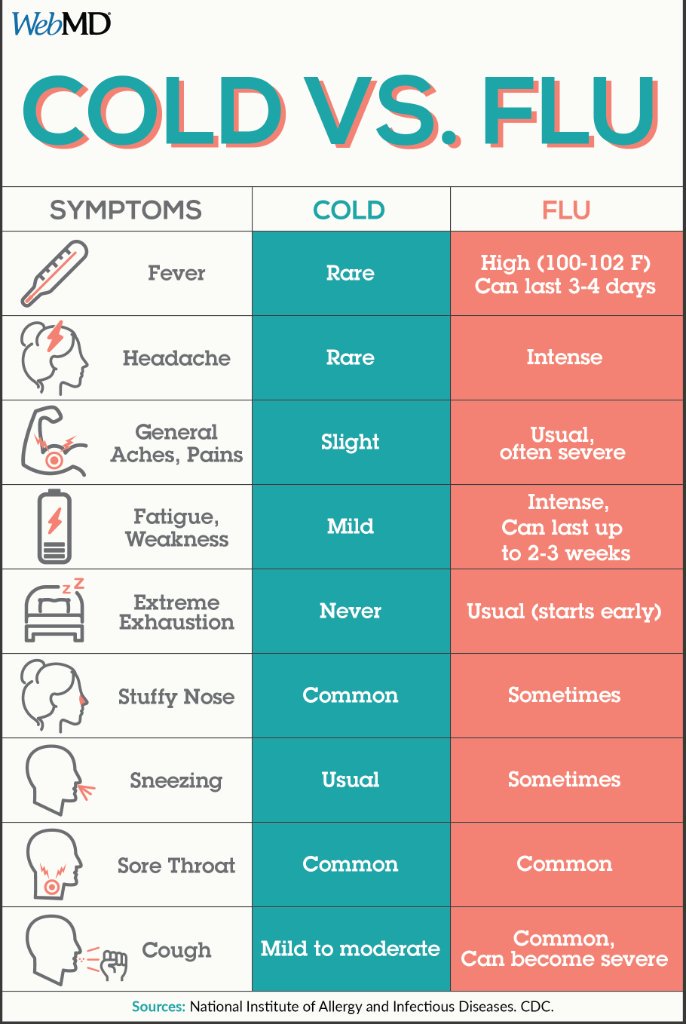
Is it a cold or the flu? The sooner you know what you have, the better you’ll treat it.