
From the National Guard Association of the United States website

The battle between Oklahoma and the Defense Department over COVID-19 vaccine mandates is heading to the courts.
The state filed a lawsuit against the Biden administration to halt enforcement of a mandate, Gov. Kevin Stitt announced last week. The move came after Defense Secretary Lloyd J. Austin III said in a memo that pay could be withheld for unvaccinated troops without an approved exemption from the vaccine requirements.
December 2 was the deadline for members of the Air National Guard to be vaccinated, under rules announced by the Air Force. Members of the Army National Guard have until June 30, 2022.
According to Air Force Magazine, more than 23,000 airmen and Space Force Guardians from across the Total Force were unvaccinated as the deadline passed.

From the Department of Veterans Affairs (VA) website
Parkinson’s disease (PD) is the second-most common neurodegenerative disease after Alzheimer’s in the U.S. One million Americans live with Parkinson’s today – and of those, approximately 110,000 Veterans with PD receive Parkinson’s treatment through VA.
While the exact cause of Parkinson’s is unknown, research suggests that its cause can be linked to genetic and environmental factors. For some Veterans living with Parkinson’s, the disease can be associated with exposure to Agent Orange or other herbicides during military service.
To make life better for Veterans with Parkinson’s, the Parkinson’s Foundation has a partnership with the VA. The top questions asked by Veterans and their family members about Parkinson’s.

The Kūkā‘ilimoku is the official e-newsletter of the 154th Wing, Hawaii Air National Guard. The first issue came in September 1957 and continues as an e-newsletter today.
Today we feature the December 1986 Kūkā‘ilimoku issue. This issue includes the following stories:
* HANG 40 Celebration
* CAMS News & Views: lots of familiar names
* HANG Outstanding Personnel
* Promotions: including Irenio Mateo, Anne Tengan
* 154th Civil Engineering Squadron News
From the Medical News Today website

Muscular dystrophy (MD) is a group of over 30 genetic diseases causing progressive weakness and loss of muscle mass. Although there is no cure, medication and physical therapy can reduce symptoms and slow the condition’s progression.
Genetic changes cause MD. These mutations change how the body produces and maintains healthy muscle tissue.
MD is more prevalent in males than females. The most common form, Duchenne muscular dystrophy (DMD), affects approximately 1 in 3,500 male births. Although it typically affects young children, other variations can appear in adulthood.
Currently, there is no cure for MD. Physical therapy and certain medications can slow its progression and improve a person’s quality of life. Researchers are working on developing gene therapies that may provide hope for people with certain types of MD.
Read more to learn about the different types of MD, what causes it, and how people can manage it.

In honor of the Pearl Harbor anniversary, we look at some interesting facts related to the “date which will live in infamy”. Hosted by Benari Poulten, a Master Sergeant in the U.S. Army Reserve and veteran of Operation Iraqi Freedom and Operation Enduring Freedom.
From the National Park Service website

Nationalistic and militaristic fervor in Imperial Japan and a strong belief in Japan’s destiny and divine right to rule all of Southeast Asia brought Japan and the United States into increasing diplomatic confrontation throughout the 1930s. Compounding the matter was a bloody undeclared war the Japanese were waging in China and the weakening of European control in Asian colonies as a result of the Second World War.

The C-Ration, or Field Ration, Type C, was a prepared and canned wet combat ration intended to be issued to U.S. military land forces when fresh food (A-ration) or packaged unprepared food (B-ration) prepared in mess halls or field kitchens was not possible or not available, and when a survival ration (K-ration or D-ration) was insufficient.
Development began in 1938 with the first rations being field-tested in 1940 and wide-scale adoption following soon after. Operational conditions often caused the C-ration to be standardized for field issue regardless of environmental suitability or weight limitations.
Note that cigarettes were part of the C-Ration.
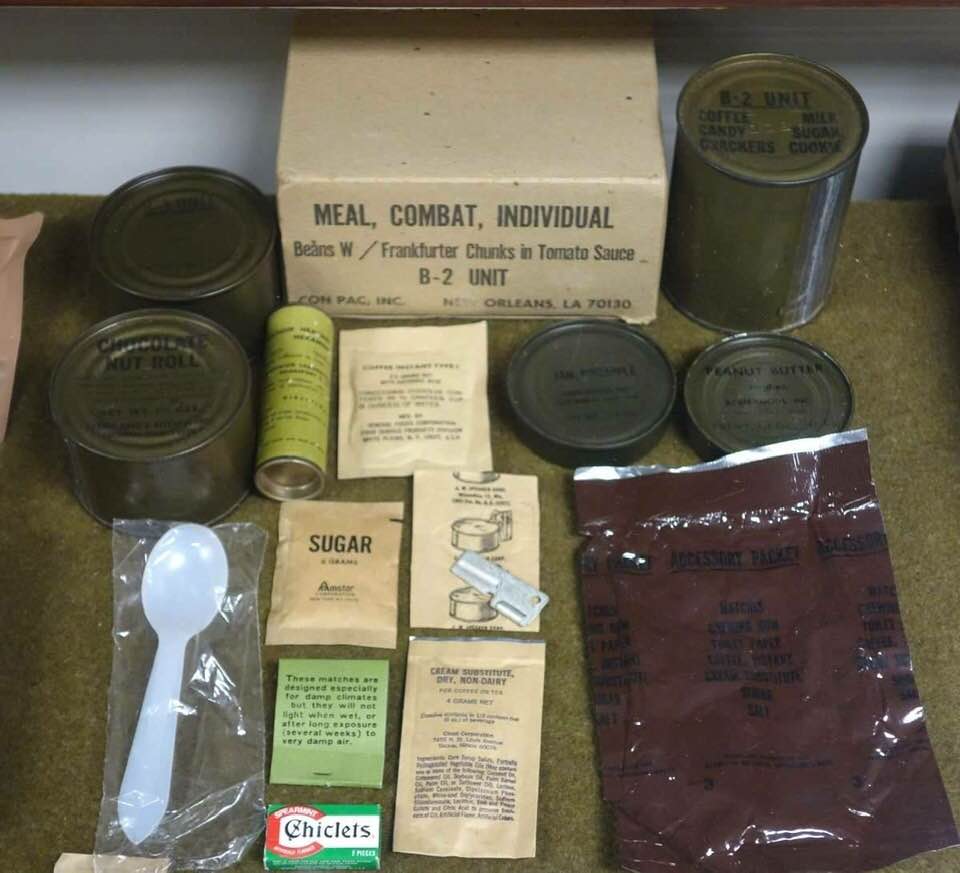
The C-Ration was replaced in 1958 with the Meal Combat Individual (MCI). Although officially a new ration, the MCI was derived from and very similar (canned wet combat rations) to the original C-Ration, and in fact continued to be called “C-Rations” by American troops throughout its production life as a combat ration (1958–1980).
In the middle of the photograph is a P-38 can opener. Review an earlier Retiree News post about P-38s

The Meal, Ready-to-Eat (MRE) is a self-contained, individual field ration in lightweight packaging bought by the United States Department of Defense for its service members for use in combat or other field conditions where organized food facilities are not available.
Although the replacement for the MCI, the MRE, was formally adopted as the Department of Defense combat ration in 1975, the first large-scale production test did not occur until in 1978 with the first MRE rations packed and delivered in 1981.
While the MRE officially replaced the MCI in 1981, previously packed MCI rations continued to be issued until depleted.
The Kūkā‘ilimoku is the official e-newsletter of the 154th Wing, Hawaii Air National Guard. The first issue came in September 1957 and continues as an e-newsletter today.
Today we feature the December 1994 Kūkā‘ilimoku issue. This issue includes the following stories:
* 154th Group headed to Turkey
* 1994 HIANG Award winners
* ESGR Luncheon
* Promotions: including Norman Kaleo, Richard Shoda, Anthony Seyko, Dean Tasaka
* MXS News and Views
* Sports News

Many seniors struggle in retirement once they move over to a fixed income that consists largely of Social Security. If you’re in that boat, you may be considering a reverse mortgage.
Steve Irwin, President of the National Reverse Mortgage Lenders Association, reports that these loan products are becoming increasingly popular. “We saw a 34% year-over-year increase in reverse mortgage volume to over 43,000 loans in 2020,” he says, “and we anticipate a similar increase in production in 2021.”
But is a reverse mortgage right for you? Here’s how to know.
If you’ve been sidelined by a sore back, you’re not alone. Four out of five people experience back pain at some point, making it the second most common reason for visiting the doctor.

Back pain takes various forms, from a persistent dull ache to sudden sharp pain, and has many causes. Sometimes it results from a sprain, fracture, or other accidental injury. It can stem from a disease or medical condition, such as arthritis, fibromyalgia, or spinal stenosis (a narrowing of the spinal canal through which the spinal cord runs).
Many people develop back pain in part because they’re overweight or sedentary.
The good news is that most lower back pain usually gets better within a few days or weeks, and surgery is rarely necessary. What’s more, simple self-help strategies such as these can be surprisingly effective at preventing back pain and keeping it from returning:

Former Sen. Bob Dole, a Kansas lawmaker and decorated World War II veteran who never realized his ambitions to win the presidency but left an indelible mark on the nation’s capital and history, died Sunday. He was 98.
Dole died in his sleep, according to an announcement from the Elizabeth Dole Foundation.
For all his accomplishments, Dole wanted to be remembered for his service – particularly as a soldier who lost the use of his right arm on the battlefield in Italy. He described to Fox News in May 2013 how he wanted to be remembered: “Veteran who gave his most for his country.”
Bob Dole was a friend across the aisle of Dan Inouye going back to the long months both spent in the same Army hospital recovering from WWII wounds.

The Kūkā‘ilimoku is the official e-newsletter of the 154th Wing, Hawai’i Air National Guard. The first issue came in September 1957 and continues as a monthly newsletter today.
Today we feature the December 2007 Kūkā‘ilimoku issue. This issue includes the following stories:
* 203rd Air Refueling Squadron’s IRRE
* Student Flight’s community service
* 154th Services Flight bivouac
* Galen Ho and Reynaldo “Rey” Delmacio promoted to master sergeants while deployed
* Sports News
* 150th Aircraft Control & Warning Squadron’s Pau Hana paina

This undated photograph shows four Airmen in an office setting. Based on the uniforms, this was in the 1950s when the 199th Fighter Squadron was located in Area 65 on Hickam AFB.
The second Airman from the left looks like Wallace Whang, who served many years in the maintenance complex.

The buoyant stock market has swelled the amount of money Americans have in their retirement savings plans, which is undoubtedly a welcome development for seniors who will need that money to live on. But most of the more than $13 trillion in savings is stockpiled in tax-deferred plans, which means retirees will eventually have to pay taxes on it. And depending on the size of the account, that tax bill could be significant.
To prevent retirees from avoiding taxes forever, the IRS requires owners of traditional IRAs and other tax-deferred accounts, such as 401(k) plans, to take minimum withdrawals based on their life expectancy and the balance of their accounts at year-end. The Setting Every Community Up for Retirement Enhancement (SECURE) Act, which was signed into law in December 2019, increased the age at which you must begin withdrawing money from 70½ to 72. Legislation pending in Congress would gradually increase the age for required minimum distributions to 75 by 2032.

 Retiree News