Services for Sergeant Drew M. Scobie, a casualty in a theater of combat operations are set.
Date: Saturday, February 15, 2014 Time: 0830-1030 Visitation, Services at 1045 Place: Hawaiian Memorial Park Chapel 45-425 Kamehameha Highway, Kaneohe BG Bruce Oliveira, Commander of the Hawai‘i Army National Guard shared this PTC video regarding SGT Scobie. http://www.pentagonchannel.mil/Video.aspx?videoid=319865#.UuxIa17LK-E.email Address of individual concerned for mailing of letters of condolence: SFC Lesley R. Pasion gofundme.com/In-Memory-of-Drew-ScobieATTN: McKenna Panui-Scobie
A TRP 1-299 CAV
96-1210 Waihona Street
Pearl City, HI 96782
 click on photograph to enlarge
Congratulations to Arthur and Rene Kimura for being named 2014 Honpa Hongwanji of Hawaii Living Treasures. They were recognized at the annual luncheon and recognition ceremony to be held on February 8, 2014, at the Sheraton Waikiki Hotel.
This husband and wife team was recognized for their collaborative efforts in promoting education in science for students throughout Hawaii. Both have been recognized locally and nationally for their outstanding achievements and dedication to science education. These include receiving the first Presidential Award for Excellence in Science in 1983, and the Christa McAuliffe Memorial Award for Excellence, presented by the Aerospace Education.
Art is a retired lieutenant colonel who served with the 154th Wing.
No new registered readers this week.
You can register to receive an email every time there is a new post. In the “Follow Blog via Email” section and press “Follow”. On the next screen, enter your email address and press ENTER. Shortly, you will receive a confirmation email to your address from WordPress.com. You acknowledge the email and you are a registered reader.
After you compete this short registration process, you get a notification email every time there is a new posting. The email has a quick teaser of the posting, along with tags that indicate how the posting relates to special topics/areas.

Wright Ernest “Buddy” Upchurch, 76, retired Quality Assurance Specialist for Rockwell Intl. Rocketdyne Division, passed away on December 12, 2013 at Pali Momi Medical Center. He served in the Hawai‘i Air National Guard in the 1960s and 70s before moving to California. He was born in Punchbowl on February 14, 1937.
He is survived by: Wife: Margaret Upchurch; sons: Allen Upchurch, Ransom Upchurch, Wesley Upchurch; daughter: Anna Upchurch; 8 grandchildren, 2 great grandchildren; brother: James Upchurch; sisters, Caroline St. Germaine, Roberta Kalilikane. Many extended family and friends.
The Air Force Association is introducing its new membership option, the eMember. An eMembership will be identical to the current membership in every way except one: eMembers will not receive the print copy of Air Force Magazine, but rather only the online version. eMembers will have access to all other current member benefits, including eligibility to hold office and vote. For now, eMemberships will cost $30.00 for a year. In addition to the eMembership, AFA is moving over the next few months toward implementing a members-only area that will restrict access to online airforcemag.com content. Both current members and new eMembers will have full access to all of the online content.The launch of the eMembership speaks to AFA’s efforts to meet the digital demands of today’s society. This change also supports AFA’s activities to grow a robust and engaged membership to further the Association’s mission. AFA will make announcements as it advances toward the full implementation of the eMember category and member-only airforcemag.com content. For more information or to become an eMember, visit http://www.afa.org/AFA/Join.
The National Commission on the Structure of the Air Force recommended disestablishing Air Force Reserve Command and its numbered Air Forces in an effort to realign Air Force headquarter functions and rebalance the Total Force. “As the Air Force progresses toward fuller integration at the unit level, the need for an (AFRC) as a ‘force providing’ headquarters declines, as does the need for its subordinate (NAFs),” states the commission’s report.
Commission Chairman Dennis McCarthy said the report, released last week, recommends the position of Chief of the Air Force Reserve be retained, and along with the Director of the Air National Guard, will still have direct access to the USAF Chief of Staff. “It’s a dual-hat position, and we recommended taking away one of the hats,” he said. AFRC’s units and functions would be taken over by USAF headquarters and the major commands, with increased representation. The proposal will likely attract some discomfort from current AFRC leadership, but McCarthy said the hope of the commission is that the Reserve will see the opportunity for fuller integration into USAF and the long-term benefits and savings for the Total Force.
As the Air Force more fully integrates the Reserve into units and wings, the commission argues, the process of fielding equipment across the ARC and the Active Duty will become easier with time. (NCSAF report; caution, large file)
Last year, Stephen Lum of the department’s Public Affairs Office completed a photo gallery recognizing the eighteen individuals who served as Hawai‘i’s adjutants general through the years. Each photo includes short biography of officer. This photo gallery is in the hallway outside the Adjutant General’s office here at the State Headquarters.
Special thanks to Steve for another superb job.
To share Steve’s hard work, we will post one of the photos each week. This week’s photo features Hawai‘i’s fifteenth Adjutant General, Major General Edward V. Richardson.
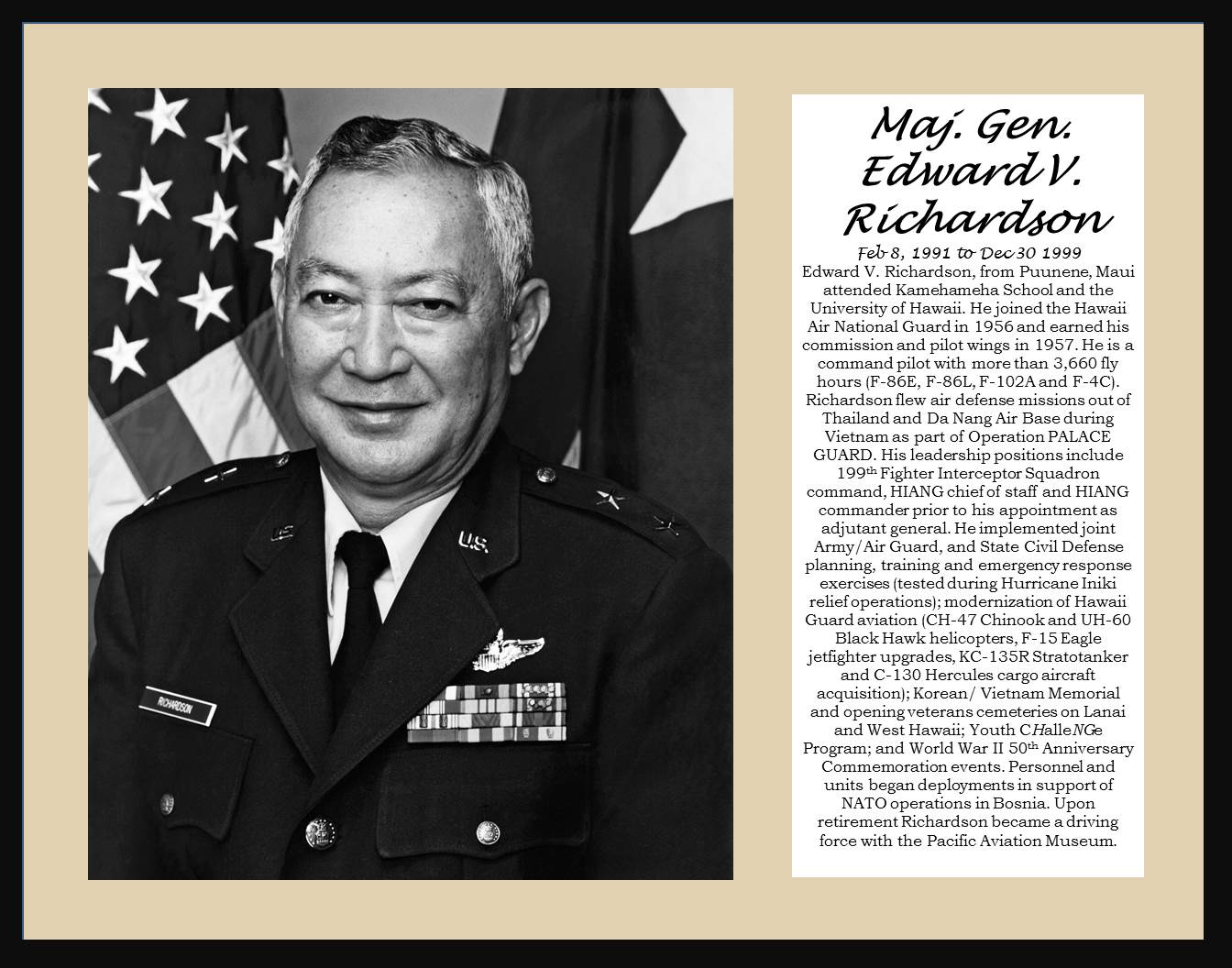 click on photograph to enlarge
Thanks to these Retiree News readers who registered to “Follow Blog via Email”: Alan Umeda
Thanks for the following new registered readers whose email address did not include a recognizable name: aztec55, norbreeze, hap.e.one

The December 2013 edition of the e-Afterburner has been posted on the Air Force retiree website at www.retirees.af.mil. The new edition is located on the Afterburner page under the 2013 tab, or by clicking here. This edition is available in.pdf format for downloading and printing.
“COLA-minus-one” plan will affect younger military retirees.
By Jim Garamone, American Forces Press Service
WASHINGTON, Jan. 28, 2014 – The Defense Department must slow the rate of growth in military pay and compensation or the organization will not be able to fight and win the nation’s wars, Acting Deputy Defense Secretary Christine H. Fox said here today.
|

Fox, testifying before the Senate Armed Services Committee, said DOD must get a handle on pay and benefits or risk sending service members into harm’s way unprepared.
The deputy thanked the senators for supporting the Bipartisan Budget Act, which she said mitigates the worst of the problems DOD faces under the Budget Control Act of 2011. Still, she added, it only goes through the next two years, and this is a long-term problem.
“Beyond those two years, the BCA remains the law of the land,” she said. “If sequestration is allowed to persist, our analysis shows that it will lead to a force that is too small, inadequately equipped and insufficiently trained to fully defend the nation’s interests.”
Given this budgetary background, DOD civilian and military leaders have said time and again that the one-third of the defense budget consumed by military compensation cannot be exempt as an area of defense savings. “We must find ways to slow the rate of growth,” Fox told the committee.
Inflation-adjusted pay and benefit costs are 40 percent higher than in 2001, even though the active force today is just slightly larger. Defense health care costs alone have grown from less than $20 billion in 2001 to nearly $50 billion in 2013. Payments for housing costs also have increased faster than inflation.
“If this department is going to maintain a future force that is properly sized, modern and ready, we clearly cannot maintain the last decade’s rate of military compensation growth,” Fox said.
Military service is about more than just a paycheck. The jobs and service military personnel perform are as important. If the department doesn’t have money to maintain equipment, or supply the latest technology, or get service members the latest and best training “then they are being done a disservice,” the deputy said.
“When they’re sent into harm’s way, this disservice can quickly transition into a breach of trust,” Fox said. “Here I am referring to our collective, sacred obligation to provide our troops with the finest training and equipment possible, so that they can deploy to combat able to accomplish their mission and return to their families.”
The department does have recommendations for slowing the growth of compensation fairly and effectively, Fox said. “Most notably, just this year, Congress accepted a 1 percent basic pay raise, even though the employment cost index called for an increase of 1.8 percent. We are currently reviewing all military pays and benefits, and may offer further proposals.”
Fox spoke directly to the “COLA-minus-one” or “CPI-minus-one” provision included as part of the Bipartisan Budget Act. The provision required capping cost-of-living raises in retirement pay for working-age military retirees at 1 percent below inflation, as measured by the Consumer Price Index.
“To my knowledge, no DOD officials were consulted on the details of the BBA, including the CPI-minus-one provision,” she said. “The department fully supported the changes made to the provision to exempt military disability retirement and survivors.”
The department does support a comprehensive review of this provision, the acting deputy defense secretary said, including its effect on retirees not currently exempted. “If the Congress decides to retain the CPI-minus-one approach, we strongly recommend it be modified to include ‘grandfathering,'” she said.
Fox called on Congress to refrain from changing military retirement until the Military Compensation and Retirement Modernization Commission presents its final report in February 2015.
“There are many ways we might change military retirement, including more fundamental reforms,” she said. “Because the CPI-minus-one provision does not go into effect until December 2015, there is ample time for such a careful review, including waiting for the commission to provide its input.”
Washington, DC. At 10am EST today, EANGUS staff attended the briefing of the final report of the National Commission on the Structure of the Air Force. The eight commission members submitted the report, and Chair Dennis McCarthy gave a verbal summary of their findings. Each of the other seven commission members then provided their comments.
The Russell Senate Office Building room was packed with nearly 80 people, representing military associations, news agencies, and congressional staff. More than a dozen questions were posed, including one from EANGUS Executive Director Al Garver. He asked commission members if they favored the formation of a National Commission on the Structure of the Army and, with a smile, asked if any of them were interested in volunteering to serve on it. The commissioners burst into laughter and were unanimously shaking their heads “no” to the second part of the question, but didn’t initially answer the first portion.
Maj Gen Ed Tonini, Adjutant General, Kentucky, asked the same question again a few moments later and former Acting Secretary of the Army, Les Brownlee, answered that there are significant differences between Army and Air Force utilization of reserve components; as such, he cautioned that this report applies solely to the Air Force, and its conclusions were not readily transferrable to the Army. A more detailed explanation of his thoughts on this issue can be found on page 67 of the official report.
EANGUS has performed a quick review of the 127-page final report, which includes 42 specific recommendations, and the report is highly favorable of increasing future utilization of the Air National Guard and Air Force Reserve. Perhaps the most striking evidence of this can be found on page 36:
The Commission estimated that it is feasible to shift the Air Force component mix from the current 69% Active and 31% Reserve to 58% Active and 42% Reserve. This would result in the shift of approximately 36,600 personnel and yield savings of perhaps $2 billion per year in manpower costs with no reduction in Total Force end strength. If this shift were proportionately allocated to the Air National Guard and the Air Force Reserve, the resultant increases would amount to 14,100 Airmen in the AFR and 22,500 in the ANG; nearly all would be part time.
EANGUS recommends any interested parties read through the final report. It is incredibly well written, and replete with relevant facts and insights. The link to the full report pdf is:
http://afcommission.whs.mil/public/docs/AF%20Report.pdf (slow load)
Air Force Secretary Deborah James said Wednesday she expects a key finding of the National Commission on the Structure of the Air Force’s report, which will be released today, to be a larger USAF role for the reserve component. “There’s no doubt our Air Force will rely more, not less, on the Air National Guard and Reserve,” James said at an AFA-sponsored, Air Force breakfast in Arlington, Va. She’s looking forward to the report, and said she expects it to complement and inform ideas presented at upcoming posture hearings. It will support her goals of “growing a capable Air Force for tomorrow’s challenges.” And it will help her and service leadership hash out “what it is the nation might ask us to do.” Although, the end result is already predictable, she said: “A smaller Air Force, highly capable, with cutting-edge technology.”
Taken from the Air Force magazine’s daily e-newsletter
By Jim Garamone, American Forces Press Service
WASHINGTON, Jan. 28, 2014 – Contrary to some news reports, there are no plans to close military commissaries, the chairman of the Joint Chiefs of Staff said.
But Army Gen. Martin E. Dempsey added that the budget environment is forcing the department to look for savings anywhere possible.
The chairman first addressed this issue during his Facebook town hall meeting last month.
The Joint Staff did not ask the Defense Commissary Agency to come up with a contingency plan to close 100 percent of U.S. commissaries, senior military officials said. Officials did ask the Defense Commissary Agency for a range of options, including how the system would operate with reduced or no taxpayer subsidies, the chairman said, noting that military exchanges work on this system and that the same potential exists with commissaries. In the most recent year, the Defense Commissary Agency received $1.5 billion in subsidies.
“But we haven’t made any decisions,” the chairman said. “We’ve got to drive toward greater efficiencies, and this is just one of the potential areas.”
The Bipartisan Budget Act, which President Barack Obama signed earlier this month, alleviated some of the sequester pressure on the department through fiscal year 2015. But the Budget Reduction Act of 2011 is still law, and sequester-level spending cuts will be back in play in fiscal 2016, unless Congress changes the law.
Still, the chairman said, the department must find ways to ensure that service members are prepared to perform their missions.
“We’re well aware of the need for acquisition reform, as well as the need to reduce unnecessary infrastructure and retire unneeded weapons systems,” Dempsey said. “All of the institutional reforms are intended to produce a single outcome: the best-trained and best-equipped service men and women on the planet.”
William Kauhane Malakaua, 64, of Mountain View, Hawai‘i, a retired Hawai‘i Army National Guard sergeant first class and Triple Canopy Inc. international security employee in Kuwait, died in Kuwait City, Kuwait on January 22, 2014. He was born in Hilo.
He is survived by wife Lisa M.; sons Duke K. Malakaua and Christopher G. Kopp; daughter Brittany N. Romero; brothers Darell and Randall; sisters Carolyn Pfahler, Trudy Yamada and Jamie Malakaua; and four grandchildren.