Last year, Stephen Lum of the department’s Public Affairs Office completed a photo gallery recognizing the eighteen individuals who served as Hawai‘i’s adjutants general through the years. Each photo includes short biography of officer. This photo gallery is in the hallway outside the Adjutant General’s office here at the State Headquarters.
Special thanks to Steve for another superb job.
To share Steve’s hard work, we will post one of the photos each week. This week’s photo features Hawai‘i’s seventeenth Adjutant General, Major General Robert G.F. Lee.
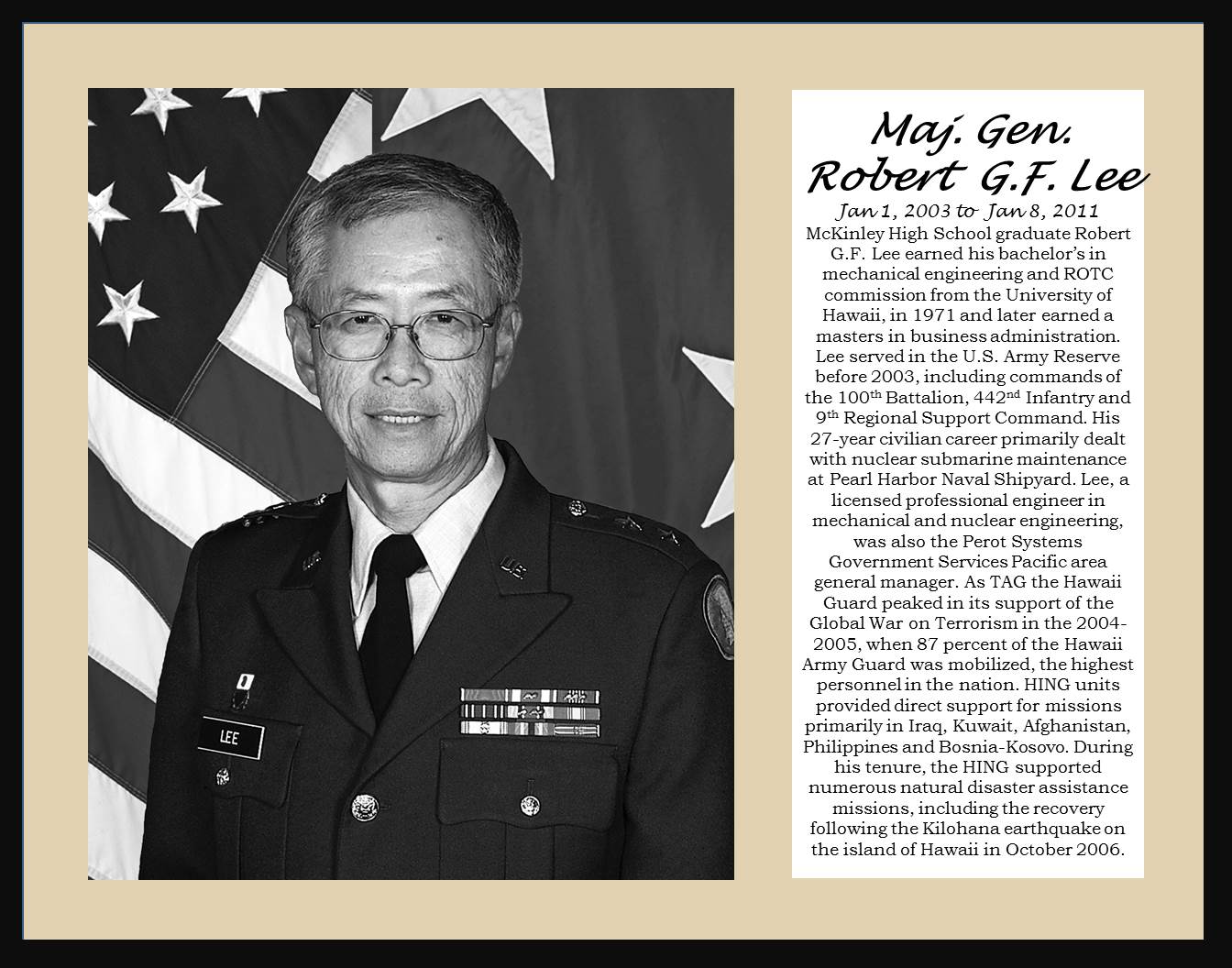 click on photograph to enlarge
If you’ve earned a government pension, you may be eligible for reduced spousal or widow’s benefits. http://ow.ly/tFnzY
Congratulations to Col Suzanne Vares-Lum, who recently started fulltime at the State Headquarters as the Deputy Chief of the Joint Staff. Know she will do a great job!
Ran into Kyle Kamikawa, HIANG retiree who served many years in the avionics branch of the 154th Aircraft Maintenance Group. He still works at Pearlridge maintaining their monorail system there. Great seeing Kyle!
Happy to report Carswell “Caz” Ross competed his cancer treatments and is doing well. Although he retired from the Office of Veterans Services last year, he still testifies at the legislature supporting veteran’s bills. He also supports bills dealing with the Civil Air Patrol, an organization he continues to serve in a leadership position.
Keep Tracey Saiki in your thoughts. She survived her recent stroke and has started her rehab regimen. It will be a long road, but we all know Tracey is a fighter.
Thanks to these Retiree News readers who registered to “Follow Blog via Email”: Dennis Kawamura, Stan Heu, Rex Koga, Louis Stibbard
Thanks for the following new registered readers whose email address did not include a recognizable name: htalaro, at1gik
You think your wireless and other technology is safe? From Blue Tooth to automobile remotes, PCs, and “secure” credit cards, Hacker extraordinaire shows how nearly every secure system is vulnerable. http://youtu.be/hqKafI7Amd8
Thanks to Walter Lai for sharing this information.
This was on NBC News and thought I should send it to all my friends on Medicare as fair warning. I’ve included the segment for you to view. Basically, if I understand it correctly, do not let the hospital admit you with the words, “Under Observation.” Insist on “In-Patient” designation. Otherwise, you will be responsible for the hospital expenses. It might be wise to inform family members too. This is for everyone…you may have parents, or know someone who is on Medicare. This is “good to know” information.
View the video http://www.nbcnews.com/video/nightly-news/54026469/#54026469
Thanks to Dennis Kamimura for becoming the 300th Retiree News registered reader.
He retired from his job as the licensing administrator at the Department of Motor Vehicles in November 2013. He held that position since 1978.
Dear Colleague:
In December, I wrote to tell you about some upcoming changes to the services we provide at Social Security offices across the country. Based on feedback we received from many of our stakeholders, we decided to delay the implementation of these changes to later in the year.
Beginning August 2014, we will no longer issue Social Security number printouts in our field offices. Individuals who need proof of their Social Security number and cannot find their card, will need to apply for a replacement card.
In addition, beginning October 2014, our field offices will stop providing benefit verification letters, except in emergency situations. Benefit verifications are available online, and can be obtained anytime by registering for a my Social Security account located at: www.socialsecurity.gov/myaccount, or requested through our national toll-free number: 1(800)772-1213.
Please share this information with others in your organization, and help us get the word out to all of your members and constituents. To assist your outreach activities, we developed and updated outreach materials on our third party page at: http://www.socialsecurity.gov/thirdparty/whatsnew.html.
I appreciate your continued support helping to inform the American people about these important service changes.
Sincerely,
Jane Yamamoto-Burigsay Public Affairs Specialist Social Security Administration Honolulu/Kapolei Districts PH: (855)601-2478 ext.31348 FAX:(808)541-3534 http://www.socialsecurity.gov/ Thanks to Fred Hyun for sharing this information.Senator Will Espero and Representative K. Mark Takai are hosting a Military & Veterans Day at the State Capitol. The flyer below has more information.
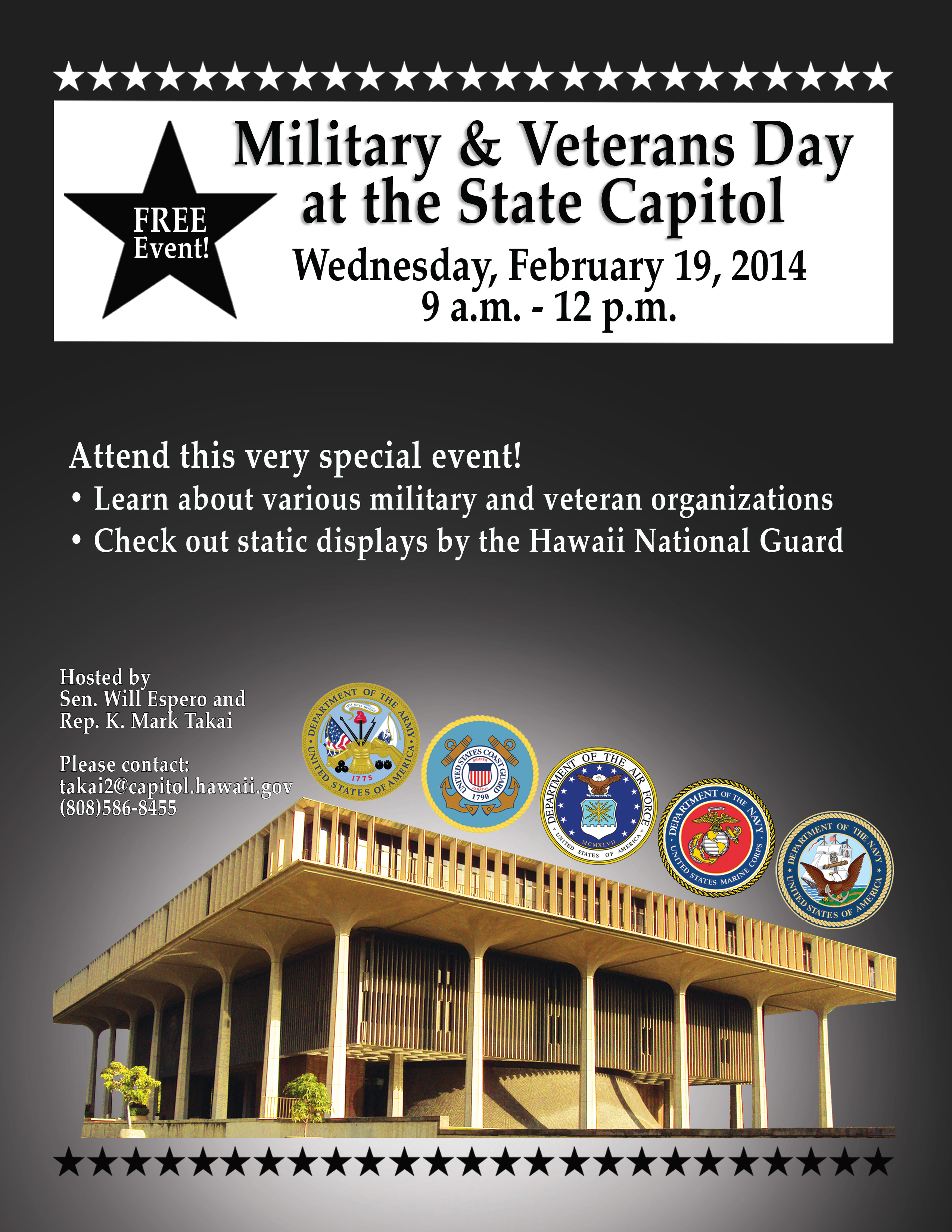 click on photograph to enlarge
Teruo Oshiro, 86, of Kekaha, Kauai, a Hawai‘i Air National Guard retiree, passed away on February 2, 2014. He was born in Lawai, Kauai.
He is survived by wife Florence Tomita; daughters Nancy Berson, Kerry Han and Lisa Tomita; brothers Shige, Yoshi and Rodney; two grandchildren; and two great-grandchildren.
LeRoy Bow Chong Yuen, 78, of Honolulu, a Public Utilities Commission director and a Hawai‘i Army National Guard veteran, passed away on February 5, 2014. He was born in Honolulu.
He is survived by wife Eva; son Marty; daughters Tammy Rodrigues, Tracy Nimura and Marlene Yuen; brothers Herbert, Albert and Stanford; sisters Myrtle Choan, Maxine Lum, Sharon Lau and Lauralei Takahata; and four grandchildren.
The Air Force activated the 203rd Air Refueling Squadron on February 12, 1992. Now in it’s 21st year, the squadron has grown and it’s missions expanded. Many of the original members have moved on or retired, but many memories remain.
On February 12, 1994, the squadron hosted a first birthday celebration, a “baby” luau in local tradition. The squadron auditorium (in their old facility) was the place. It was decorated in traditional style with the squadron members preparing the food.
The Master of Ceremonies was then Maj. Stanley Osserman. He introduced the guests, among them, Maj. Gen. Edward Richardson, the Adjutant General and Brig. Gen. David Rodrigues, Commander of the Hawai‘i Air National Guard. Both spoke of the squadron’s humble beginnings and the accomplishments of their first year.
The squadron commander, the then Lt. Col. Walter Kaneakua was proud of his unit and grateful for their hard work, success and growth. “We started with nothing,” he said.
Happy Birthday to the 203rd Air Refueling Squadron!
This posting was based on an article, written by SSgt Stephen Thomas that appeared in the April 1994 issue of the Kūkā‘ilimoku, the newsletter of the 154th Wing.
Last year, Stephen Lum of the department’s Public Affairs Office completed a photo gallery recognizing the eighteen individuals who served as Hawai‘i’s adjutants general through the years. Each photo includes short biography of officer. This photo gallery is in the hallway outside the Adjutant General’s office here at the State Headquarters.
Special thanks to Steve for another superb job.
To share Steve’s hard work, we will post one of the photos each week. This week’s photo features Hawai‘i’s sixteenth Adjutant General, Major General Edward L. Correa, Jr.
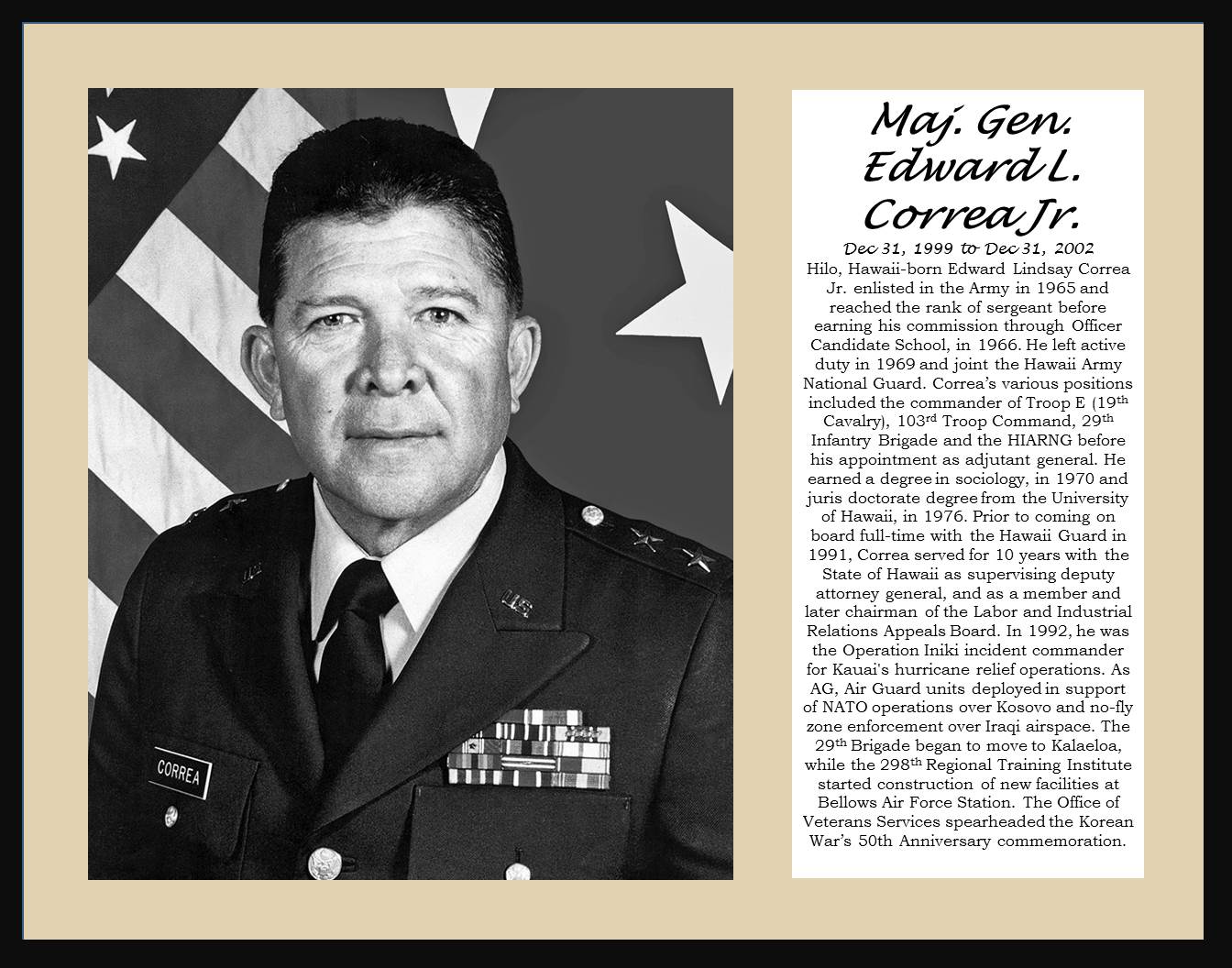 click on photograph to enlarge
A quartet of prominent defense think tanks presented a range of recommendations last week as alternatives to the upcoming Quadrennial Defense Review and the imminent Fiscal 2015 budget. Teams from the American Enterprise Institute, the Center for a New American Security, Center for Strategic and Budgetary Assessments, and the Center for Strategic and International Studies all developed their own strategies to rebalance the Defense Department’s major weapons systems, capabilities, and spending priorities in light of post-sequestration budget constraints.
Using a force-building tool built by CSBA, all four teams came up with their own plans for the next two future years defense plans, from Fiscal 2015-19 and Fiscal 2020-2024. The first follows sequester caps and the second allows more funding to buy capabilities back. In both scenarios, all four teams proposed retiring Active Duty A-10s and U-2s, as well as restoring Global Hawk Block 30 funds.
All the teams also proposed cutting between two and four aircraft carriers from the Navy’s fleet. All proposals said the US must embrace interoperability with allies, diversify power projection, and “anti access, area denial” capabilities to allow US forces safe areas and bases to deploy during crises. (Read more from the respective scenarios here.)