 Twenty years ago, the National Guard Bureau announced the results of the 1997 Air National Guard Majors Promotion Board. The Hawai‘i Air National Guard had a large group of officers promoted at this board.
Several of these officers went on to serve as the senior commanders. Several officers moved on to other opportunities. How many do you remember?
The units of assignment listed were as of the promotion announcement.
Earl Alamedia, Jr., 203d Air Refueling Squadron
Kenneth Bailey, 203d Air Refueling Squadron
Daniel Boyle, 203d Air Refueling Squadron
Raphael Carreiro, 154th Maintenance Squadron
Douglas Ernst, 204th Airlift Squadron
Peter Fata, 203d Air Refueling Squadron
Reynold Hioki, 297th Air Traffic Control Flight
Adrian Kinimaka, 199th Fighter Squadron
Daniel McLaughlin, 154th Medical Squadron
Myles Moriguchi, 154th Air Control Squadron
Braden Sakai, 199th Fighter Squadron
Stanley Sato, 154th Medical Squadron
Dean Shaw, 199th Fighter Squadron
Roland Smith, Headquarters 154th Wing
Gary Teed, 154th Civil Engineer Squadron
Ian Tsuchiya, 203d Air Refueling Squadron
Diann Wright, 203d Air Refueling Squadron
Deric Wong, 204th Airlift Squadron
Time really flies by….
From the everyday Health website

For the past few decades, we’ve been told that the best and healthiest dairy products are fat-free or low-fat milk, cheese, and yogurt. But more recently, this recommendation has been called into question due to a handful of studies that suggest that eating full-fat dairy products can actually be beneficial for your health. If you’re one of many who are stuck wondering whether to switch to full-fat dairy or stay in the low-fat lane, you’re not alone. I’m here to set the record straight on what the studies tell us — and what they don’t.

Dennis Dalen receiving an award from Colonel Melvin Morris, the 201st Combat Communications Group commander in 1990
Twenty-five years ago, on September 11, 1992, Hurricane Iniki devastated the island of Kauai. Governor John Waihee mobilized the Hawaii National Guard to help with recovery operations.
Three days into the recovery, TSgt Dennis Clifton Dalen died in a motor vehicle accident. When driving to Kauai’s North Shore, the truck he was driving flipped over as he tried to avoid live power lines.
Dennis was only 46 years old and a power production technician with the 297th Air Traffic Control Flight, as it was named in 1992.
Dennis was survived by his wife, Yong Sun Dalen. He is buried the Hawai‘i State Veterans Cemetery
We lost a great individual that day
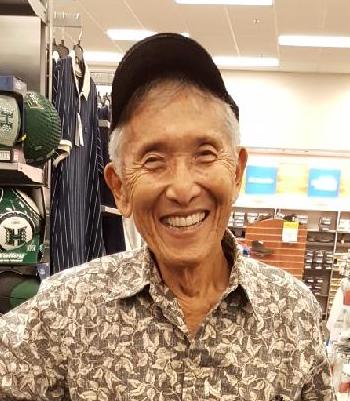 While shopping in the Navy Exchange, Eric Wong ran into Melvin Asai. Mel came off active duty and served in several positions before becoming the 154th Wing’s mobility officer. He always drove great cars that were alway clean. He was a avid tennis player with the Supply Squadron folks who played after work. Mel retired from the Hawaii Air National Guard about 20 years ago.
Special Thanks to Erik Wong for submitting this photograph to Retiree News
 From The Washington Post website
Consumers affected by the Equifax data breach are scrambling for ways to protect their financial lives. Some are considering Equifax’s own credit-monitoring service. Others suggest freezing your credit as a better option to such services. But what does freezing your credit entail, and how easy is it to do (and undo)?
 The U.S. Securities and Exchange Commission (SEC) and the Federal Retirement Thrift Investment Board are co-sponsoring a program titled “Your TSP Account – What to Think About When Nearing Retirement or Considering Leaving the Government” on Tuesday, October 3, 2017, 2:00pm-4:00pm EST at the SEC, 100 F Street, NE, Washington, DC 20549 and via public webcast. This event is open to all federal employees and members of the uniformed services.
This program is designed for federal employees and members of the uniformed services who may be considering retiring or leaving Federal Service. The program will cover TSP distribution options, withdrawals and roll-outs. Discussion will also cover fees, the common red flags of investment fraud, how to check out a financial professional, and questions to ask when thinking about moving funds from the TSP.
Go to this link on October 3, 2017, at 2pm (9am in Hawaii) to attend the program via webcast: https://www.sec.gov/video/live/470375936-tsp-presentation-100317.htm
For questions about program registration, please contact Steven Mauldin at MauldinS@sec.gov
For questions about program content, please contact Tom Manganello at ManganelloT@sec.gov.
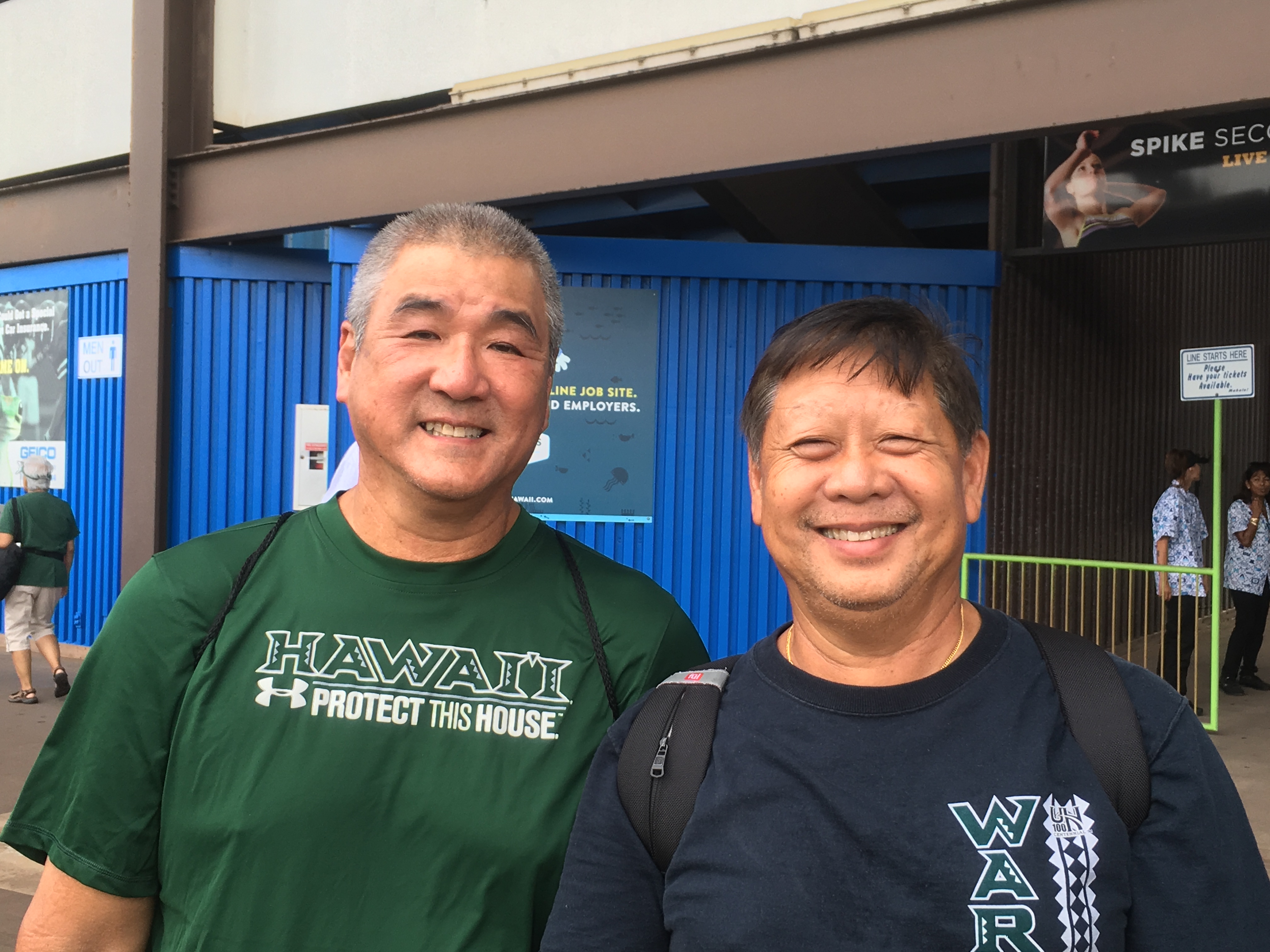
Allen Kimura and Lester Ho
We ran into two Hawaii Air National Guard retirees at the University of Hawaii – Western Carolina football game at Aloha Stadium.
Allen Kimura worked in the Structural Repair Shop. When the KC-135 Strotankers became part of the Hawaii Air National Guard, he moved to the Fabrications Section. He retired as the Fabrications Section Supervisor.
Lester Ho worked in the maintenance group and the old Military Personnel Flight.
Both are happy retirees as you can see in the photograph.
From the nextavenue website
 Kathy Rocchetti, 58, knew she needed to get in shape. It wasn’t her doctor who told her; it was her jeans.
“It was getting tough to pull them up over my hips,” the Philadelphia woman recalls, “and it was almost impossible to button them.” Now, 20 pounds lighter, those jeans glide right on and look like a million bucks.
What was the secret to her success? “Lots of things,” Rocchetti admits, including a wellness program at work. “But a big part of it were the fitness apps on my smartphone.
You can register to receive an email every time there is a new post. In the “Follow Retiree News via Email” section and press “Follow”. On the next screen, enter your email address and press ENTER. Shortly, you will receive a confirmation email to your address from WordPress.com. You acknowledge the email and you are a registered reader.
After you compete this short registration process, you get a notification email every time there is a new posting. The email has a quick teaser of the posting, along with tags that indicate how the posting relates to special topics/areas. There is a direct link to the website (Read more of this post)
 click on graphic to enlarge
Thanks to these Retiree News readers who registered to “Follow Retiree News via Email”: Rolf Oudraad, dkca
From the DOD Live website

click to enlarge photograph
Today marks Patriot Day, a national day of service and remembrance that commemorates the catastrophic events of Sept. 11, 2001, in which terrorists took the lives of nearly 3,000 people on American soil.
The Pentagon was one of those targets. When American Airlines Flight 77 hit the west wall of the building‘s first floor, it set off a chain of events that killed 125 people inside – most of whom were Army and Navy service members and employees – along with the 64 people onboard the Boeing 757. In New York, 17 Marine reservists were among the firefighters killed as the World Trade Centers collapsed.
That day was 16 years ago, but it’s one that changed life for everyone in America, as well as many across the globe. It’s what propelled many to join the military, go into civil service or just be inspired to do more for their country.
We’ve all seen photos of the devastation from that day, but here are a few lesser-seen images.
From the Wikipedia website
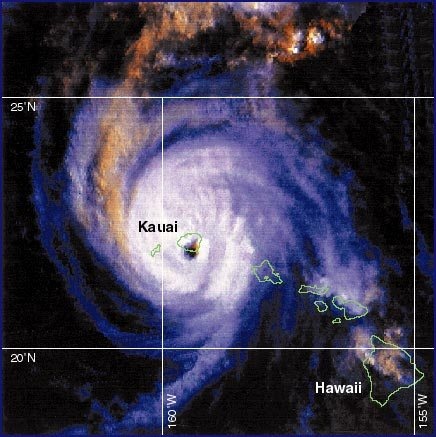
click on photograph to enlarge
Hurricane Iniki (/iːˈniːkiː/ ee-NEE-kee; Hawaiian: ʻiniki meaning “strong and piercing wind”) was the most powerful hurricane to strike the U.S. state of Hawaii in recorded history.[1] Forming on September 5, 1992, during the strong 1990–95 El Niño, Iniki was one of eleven Central Pacific tropical cyclones during that season. It attained tropical storm status on September 8 and further intensified into a hurricane the next day.
After turning north, Iniki struck the island of Kauaʻi on September 11 at peak intensity; it had winds of 165 miles per hour (266 km/h) and reached Category 5 on the Saffir–Simpson hurricane scale. It had recorded wind gusts of 225 as evidenced by a windometer that was found blown into the forest during clean up. It was the first hurricane to hit the state since Hurricane Iwa in the 1982 season, and the first major hurricane since Hurricane Dot in 1959. Iniki dissipated on September 13 about halfway between Hawaii and Alaska.
Iniki caused around $1.8 billion (1992 USD) of damage and six deaths. At the time, Iniki was among the costliest United States hurricanes, and it remains one of the costliest hurricanes on record in the eastern Pacific. The storm struck just weeks after Hurricane Andrew, the costliest tropical cyclone ever at the time, struck Florida.
The Central Pacific Hurricane Center (CPHC) failed to issue tropical cyclone warnings and watches 24 hours in advance. Despite the lack of early warning, only six deaths ensued. Damage was greatest on Kauaʻi, where the hurricane destroyed more than 1,400 houses and severely damaged more than 5,000. Though not directly in the path of the eye, Oʻahu experienced moderate damage from wind and storm surge.
Related:
LA Times article, September 16, 1992
Star Bulletin article, September 8, 2002
Hawaii News Now, 20 year summary Good videos
AccuWeather article, September 7, 2017

The September 2017 edition of NATIONAL GUARD is available online

Major Victory New GI Bill shows Washington can still accomplish big things, especially when it comes to taking care of the troops.
Reel War People’s perception of war and those who go to war is profoundly shaped by what they’ve seen at the movies.
‘The Army can’t do it without us’ A conversation with Lt. Gen. Timothy J. Kadavy, the director of the Army National Guard
Custom Made Touted as the technology of tomorrow, the military uses 3-D printing today to make specialty tools and spare parts.
The National Guard Association of the United States
One Massachusetts Avenue, NW | Washington, DC 20001 | www.ngaus.org
P: 202.789.0031 | F: 202.682.9358 | newsletter@ngaus.org
From the Wired Magazine website
 The Federal Emergency Management Agency (FEMA) has always been an odd beast inside the government—an agency that has existed far from the spotlight except for the occasional high-stakes appearance during moments of critical need. It can disappear from the headlines for years in between a large hurricane or series of tornadoes.
But FEMA’s under-the-radar nature was originally a feature, not a bug. During the past seven decades, the agency has evolved from a top-secret series of bunkers designed to protect US officials in case of a nuclear attack to a sprawling bureaucratic agency tasked with mobilizing help in the midst of disaster.